Concrete curbing drainage uses concrete borders to protect paved surfaces from erosion and water damage by directing stormwater away from the pavement. On Texas properties, proper concrete curb installation helps improve drainage and extend pavement life.
RDC Paving installs commercial concrete curbing for parking lots, retail centers, and municipal facilities across Central Texas. In this guide, we explain the most common curb styles, how they improve drainage, what installation involves, and what to consider before starting a project.
What Is Concrete Curbing?
Concrete curbing is a continuous concrete border installed along the edges of parking lots, driveways, roadways, and landscape beds to protect pavement and manage stormwater. Effective concrete curbing drainage directs runoff away from paved surfaces. This helps reduce erosion, prevent water infiltration, and extend pavement life. It also creates clean, defined edges that improve the appearance and function of a property.
Curbing vs. Curb-and-Gutter: What’s the Difference?
Concrete curbing is the raised border that directs water and defines the edge of a paved surface. Curb-and-gutter systems include an integrated channel that collects runoff and carries it to storm drains. RDC Paving installs both based on your property’s drainage needs.
Curbing vs. curb-and-gutter systems:
- Concrete curbing is ideal for landscape beds, parking lot islands, and other areas where you need basic runoff control and edge protection.
- Curb-and-gutter systems are typically used for commercial parking lots, roadways, and other paved surfaces that must collect and carry larger volumes of stormwater.
Where Is Concrete Curbing Typically Installed?
Concrete curbing is commonly installed around:
- Commercial parking lots and parking islands
- Commercial driveways and entry aprons
- Landscape beds surrounding office buildings and retail centers
- Road edges and public rights-of-way
Common Types of Concrete Curbing
The right curb profile depends on how the area will be used and how water needs to move across the site.
The four most common curb profiles used in Texas are:
1. Vertical (Barrier) Curb
A tall, nearly vertical curb commonly used in commercial parking lots and along roadways. It helps contain vehicles while directing stormwater efficiently toward drainage inlets.
2. Sloped (Mountable) Curb
Designed with a gradual slope, allowing vehicles to drive over it. It’s commonly used along residential driveways and in other low-speed areas.
3. Rolled Curb
A rounded, low-profile curb that creates a smooth transition between pavement and landscaping. It’s frequently used in neighborhoods.
4. Extruded Concrete Curbing
Also called landscape concrete curbing, concrete landscape edging, or concrete border edging, this machine-formed curb is used for decorative borders around planting beds and landscaped areas. As part of RDC Paving’s custom concrete curbing solutions, it can be colored, stamped, or shaped into unique profiles.
How Does Concrete Curbing Improve Drainage?
It’s important to balance curb appearance with the site’s drainage needs. Vertical curb profiles provide the best drainage control by directing runoff along the pavement edge. Sloped curbs, on the other hand, allow more water to flow over them and are better suited for lower-volume drainage. Extruded landscape curbing helps contain soil and mulch but should include proper drainage outlets to prevent standing water.
Decorative vs. Functional — Do You Have to Choose?
Property owners do not have to choose between decorative and functional systems. Decorative concrete curbing can improve curb appeal while still helping manage runoff when it’s properly designed and installed. Many commercial properties use stamped or colored curbing alongside concrete flatwork to create a cohesive, functional exterior without sacrificing drainage performance.
How Concrete Curbing Controls Drainage
Concrete curbing is essential to long-term site drainage because it:
Redirects Runoff on Parking Lots and Driveways
Protecting Pavement Edges From Water Damage
Preventing Soil and Mulch Runoff
Landscape concrete curbing keeps soil, mulch, and other landscaping materials contained during heavy rain, preventing them from washing onto pavement and clogging nearby drains. This is especially valuable for retail centers, office parks, HOAs, and other Texas properties where attractive landscaping and effective stormwater management go hand in hand.
What Goes Into Concrete Curb Installation
Every successful concrete curb installation starts with proper site preparation and a stable base. Commercial projects require more structural support than decorative landscape curbing to withstand vehicle traffic and direct stormwater effectively.
Cast-in-Place Curb Installation (Commercial Standard)
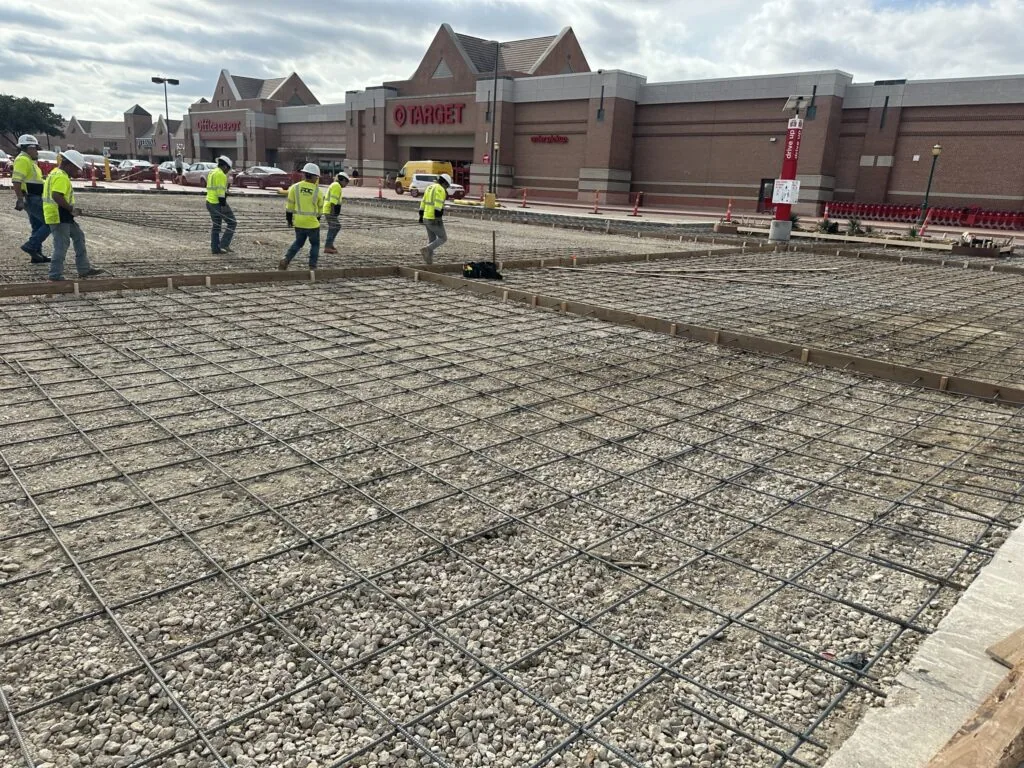
Cast-in-place curbs are commonly used for parking lots, commercial driveways, and roadways. They are carefully planned to match the property’s drainage design and local requirements. The process typically includes:
- Mark and prepare the curb line.
- Excavate and compact the subgrade.
- Set forms for the selected curb profile.
- Place and finish the concrete.
- Allow the concrete to cure before removing forms and adding expansion joints.
Extruded Landscape Curbing Installation
Extruded curbing is commonly used for landscape borders, decorative edging, and HOA common areas. The process includes:
- Prepare and compact the border area.
- Extrude continuous concrete with a curbing machine.
- Add expansion joints and decorative finishes if specified.
- Allow the curb to cure before sealing.
Stamped, colored, and custom concrete curbing follows this same process with additional finishing steps. Unlike cast-in-place curbs, extruded landscape curbing is not intended for areas exposed to regular vehicle traffic.
Factors That Affect Cost and Timeline in Texas
The cost and schedule for concrete curb installation depend on:
- Total linear footage
- Standard or custom curb profile
- Existing site conditions and subgrade preparation
- Site access and equipment requirements
- Local permit or municipal requirements
- The forecasted weather
Concrete Curbing and Drainage Mistakes to Avoid
- Choosing the wrong curb profile: Decorative curbs don’t control runoff as effectively as barrier curbs. Match the curb type to the site’s drainage needs.
- Skipping base preparation: Poorly compacted soil can cause curbs to settle and crack, especially in Texas clay soils.
- Ignoring expansion joints: Without proper joints, concrete is more likely to crack as temperatures change.
- Overlooking drainage design: Curbing should direct water where it’s intended to go.
- Using landscape curbing in traffic areas: Decorative curbing isn’t built for vehicle loads. Commercial sites require structural curbs designed for heavier traffic.
Get a Free Concrete Curbing and Drainage Project Quote
Contact our team today to schedule your pavement assessment.