A new commercial parking lot is a major investment, and the material you choose directly impacts upfront costs, maintenance needs, and long-term performance.
If you’re planning a new installation or replacing a failing lot, you’re likely weighing asphalt versus concrete. Both are widely used across Austin commercial properties, but each performs differently depending on traffic, budget, and long-term maintenance expectations.
At RDC Paving, we install and maintain both asphalt and concrete commercial parking lots throughout Austin, Round Rock, and Leander. This guide breaks down cost, durability, maintenance, and heat performance to help you choose the best option for your property.
What Makes a Commercial Parking Lot Different
Commercial parking lots are built to handle significantly heavier vehicle loads and traffic frequency than residential pavement. This requires stronger structural design, more precise grading, and full compliance with accessibility and municipal standards.
Higher Load Demands & Subbase Requirements
Commercial lots must support frequent vehicle traffic, including delivery trucks and service vehicles. Most designs include 4–6 inches of compacted aggregate base, with thicker builds required for heavier use. In Austin, clay-heavy soils also require careful drainage and compaction to prevent shifting and cracking over time.
ADA & Code Compliance
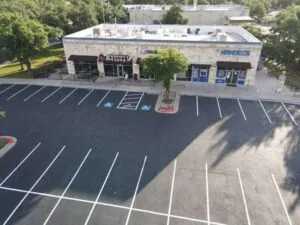
All commercial parking lots must meet ADA parking requirements, including accessible parking spaces, compliant slopes, proper parking lot striping, and clearly marked routes. These requirements apply regardless of whether the surface is asphalt or concrete and are essential for safety and legal compliance.
Asphalt vs. Concrete: Side-by-Side Comparison for Austin Commercial Lots
Both asphalt and concrete are durable, long-lasting options for commercial parking lots. The right choice depends on your budget, traffic patterns, maintenance expectations, and your property’s needs.
Here’s how the two materials compare:
| Feature | Asphalt | Concrete |
|---|---|---|
| Upfront Cost | Lower upfront investment | Higher upfront investment |
| Lifespan | Long-lasting with proper maintenance | Longer service life with less routine maintenance |
| Maintenance | Crack filling, sealcoating, and resurfacing | Joint sealing and occasional repairs |
| Heat Performance | Performs well but may soften under extreme heat and heavy loads | Performs well in high temperatures and heavy-load areas |
| Repairability | Easier and less expensive to repair | Repairs can be more complex and costly |
| Installation Time | Faster installation and return to service | Longer installation and curing period |
| Environmental Factors | Recyclable and reusable | Reflects more heat and offers long-term durability |
| Appearance | Smooth, dark finish | Bright, clean appearance |
Which Material Is Right for Your Austin Commercial Property?
The best material for your commercial parking lot depends on traffic volume, vehicle weight, budget, and long-term maintenance goals. Here’s what typically makes sense based on your property’s needs.
High-Traffic Retail, Restaurant, and Office Lots
For most retail centers, office parks, and restaurants, asphalt is the most common choice. It offers a lower upfront cost, faster installation, and easier repairs. Routine sealcoating and timely repairs can help reduce long-term maintenance costs and extend pavement life.
Industrial, Warehouse, and Heavy-Load Applications
Concrete is often the better choice for properties that regularly support semi-trucks, forklifts, and heavy equipment. Its strength and resistance to rutting make it well-suited for loading docks, distribution centers, and industrial sites.
When a Hybrid Approach Makes the Most Sense
A hybrid parking lot combines concrete and asphalt in the areas where each material performs best. Concrete is typically installed in loading zones, dumpster pads, fire lanes, and entry points, while asphalt is used for standard parking stalls. When designed correctly, a hybrid lot can provide the best balance of performance, maintenance, and long-term value.
Common Mistakes Austin Property Owners Make When Paving a Commercial Lot
Even the best paving material can fail prematurely if the parking lot is poorly designed, installed, or maintained. Here are some of the most common mistakes property owners make when planning a commercial parking lot installation:
- Choosing material based on cost alone: The cheapest option is not always the most cost-effective. Traffic levels, vehicle loads, and long-term maintenance requirements should all factor into the decision.
- Skipping proper site preparation: A weak foundation can cause both asphalt and concrete to crack, settle, and deteriorate much sooner than expected.
- Using the wrong pavement design: Commercial parking lots require materials and thicknesses designed for their specific traffic demands. What works for passenger vehicles may not work for heavy trucks.
- Ignoring drainage issues: Standing water is one of the leading causes of pavement damage. Proper grading and drainage are critical for long-term performance.
- Delaying routine maintenance: Small issues can quickly become expensive repairs. Following an asphalt sealcoating schedule and addressing minor damage with asphalt resurfacing and overlays early can help extend pavement life and reduce long-term costs.
Planning a Commercial Parking Lot Project?
If you’re planning a new installation, replacing aging pavement, or unsure whether asphalt or concrete is the best choice, contact RDC Paving. Our team will evaluate your site, discuss your goals, and recommend the best solution for your Austin commercial parking lot.
We provide full-service asphalt and concrete paving, maintenance, and repair services throughout the Austin area to meet all your needs.
Frequently Asked Questions (FAQs)
Is asphalt or concrete better for a commercial parking lot in Texas?
For most standard commercial lots in Texas, asphalt is more cost-effective upfront, but concrete performs better under sustained heat and heavy loads. In Austin’s climate, concrete is best for high-traffic drive lanes and loading areas, while asphalt works well for standard parking stalls.
How thick should asphalt be for a commercial parking lot?
Commercial parking lot thickness requirements vary based on traffic volume, vehicle weight, soil conditions, and pavement design. Lots that serve passenger vehicles typically require a different pavement structure than facilities that accommodate trucks, forklifts, or heavy equipment. Our qualified paving contractors can recommend the appropriate design for your site.
How long does a commercial parking lot last?
A properly installed and maintained asphalt parking lot can often last 15–20 years or more, while concrete parking lots may last 30–50 years. Actual lifespan depends on traffic levels, drainage, site conditions, and maintenance practices.
What are the ADA requirements for commercial parking lots?
Commercial parking lots must include the required number of accessible parking spaces, compliant signage, accessible routes, and proper pavement slopes. Requirements apply to both asphalt and concrete surfaces.
How much does it cost to pave a commercial parking lot in Austin?
The cost of a commercial parking lot depends on factors such as lot size, material selection, site conditions, drainage requirements, and pavement thickness. Because every project is different, the best way to get an accurate estimate is to get a quote from a qualified local contractor like RDC Paving.